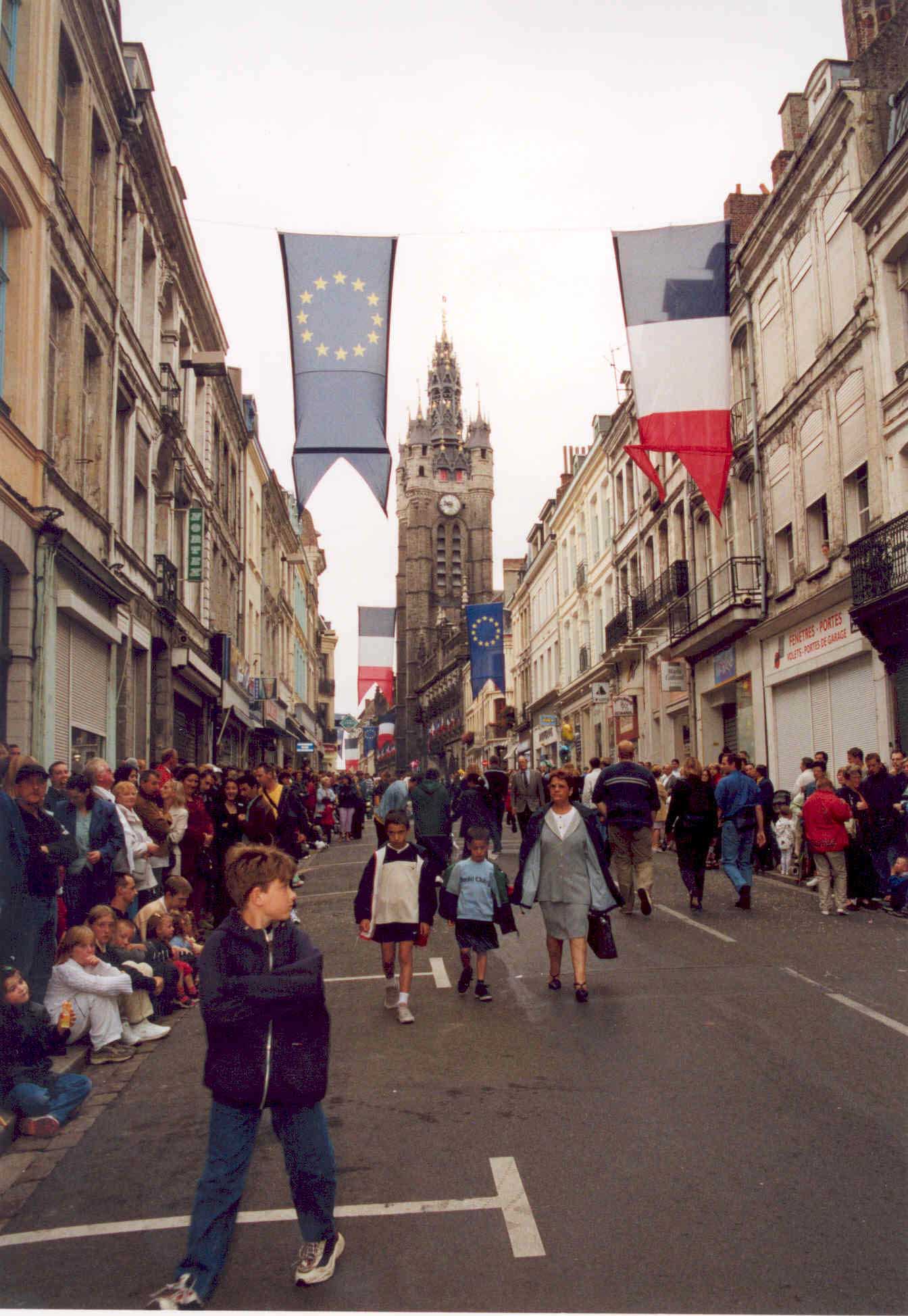
 Rue de la Mairie — Photo Dermot Carlin |
Douai’s history goes back to medieval times when it was an important trading and military centre. Its ‘parlement’ building with its spectacular
conference chamber remains a reminder of those days. Douai was the administrative centre for French Flanders under Louis XIV. The town has special links with the UK through the Douai Martyrs. More than 160 priests trained in the English College of Douai returned to England where they were tortured and killed. They are remembered in churches on their feast day, October 29th. The town grew rich on the coal and steel industries in the 19thcentury and had problems adjusting to the decline of those industries in the early 20th century. Douai was occupied by the Germans during both world wars. It was liberated by the Irish Guards after four years of German occupation during the second world war. Unfortunately many members of the resistance lost their lives before the allies finally regained the town.
|
|
Douai and its surroundings have a population of more than 200,000. The town has a fierce pride in its history. This pride is exemplified by the annual festival of the Gayant (an old spelling of giant). The town has invested in its infrastructure and preserved its heritage. There are many schools and educational establishments, including the University of Artois and the prestigious Mining College, now a centre of advanced engineering. The biggest employer is Renault, but Douai is also a thriving business centre, with a large array of small and large retailers. It also has a modern hospital, sports grounds, halls and concert venues. | 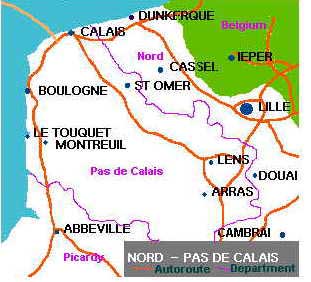
|
The centre is partly pedestrianised and the attractive River Scarpe runs through the town. Boat trips are available in the summer — a popular way of spending a sunny day.
Douai is easily reached by road from Calais via the motorway (about ninety minutes). Alternatively, Eurostar runs from Waterloo to Lille. A local train will then get you to Douai in half an hour.
The following visits are all worthwhile:
| |
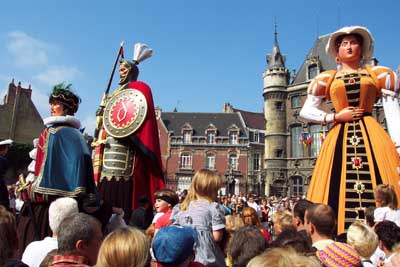 Photo Jenny Mintoft | Five colourful giants dominate the streets of Douai on one Sunday in July every year — the starring cast of the town's famous pageant of Gayant. The giants are Monsieur Gayant who stands at 30 feet tall and weighs 53 stone. He is carried by six men. He is accompanies by his lady wife at 21 feet tall and a much trimmer 36 stone. She is also carried by six men. Their children are Jacquot, Fillon and Binbin. They are 12 ft, 10ft and 8ft tall respectively, weighing in at nearly 12 stone, ten stone and more than six stone. Each is carried on the parade by one man. |
| All visitors to the town are told about the pageant or see it for themselves - but not everyone knows the story behind it. This begins on June 16th 1479. The town of Douai then belonged to Maximilian, Count of Flanders, and to his wife Marie de Bourgogne. Douai was nearly taken by the French, but its citizens managed to outwit the enemy and save the town. | 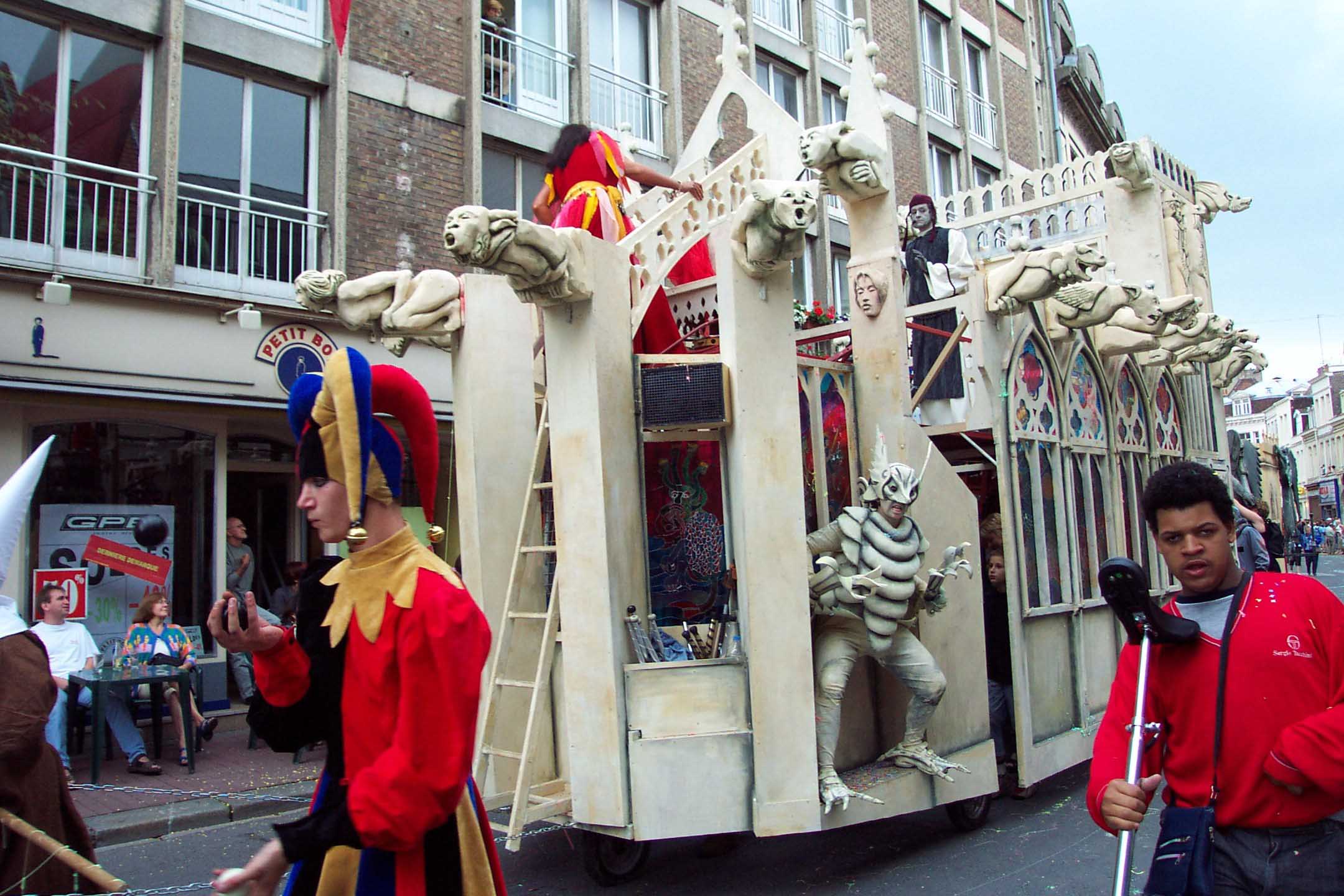 Photo Jenny Mintoft |
|
They ascribed this success to St. Maurand, their patron-saint, and decided to organise a great pageant every year to express their thanks to him. Then in 1529 a peace treaty was signed with France which enabled the population to organise a far more beautiful pageant the following year. Each of the town's guilds had to build a pageant 'car' bearing a manikin representing a symbolic scene. The Guild of Basketmakers decided to build instead a gigantic man made of osier, a species of willow much used in basket work, whom they called 'Gayant' (the Picard dialect of the French word 'Géant' or 'Giant' in English). The next year, the Guild of Fruiterers offered him a giant wife, Mme. Gayant. She accompanied her husband in all the pageants he took part in. Both Monsieur and Madame were much smaller than the giants used today - each was carried by only one man. At some points in the town's history it was decreed the giants were irreverent, upsetting the most holy, and should not be included in the pageant. They were then resurrected in later years, only to disappear some years after the French revolution of 1789 when they were condemned for being 'aristocrats' They reappeared in 1801, dressed in the fashions of the time and in 1821 they received the vestments familiar to today's onlookers and they attended the festivities every year ever since until the first world war. The giants were destroyed during both world wars. Then in 1944 they were brought to life again thanks to the love the inhabitants of Douai felt for them. Every year the couple, accompanied by their three children, a wheel of fortune and the Sot des Cannoniers - a kind of fool riding a hobby horse - can be seen marching through the streets of Douai to the sound of a beating drum. It is a spectacle, filled with colour, fun and history, which is not to be missed.
| |